
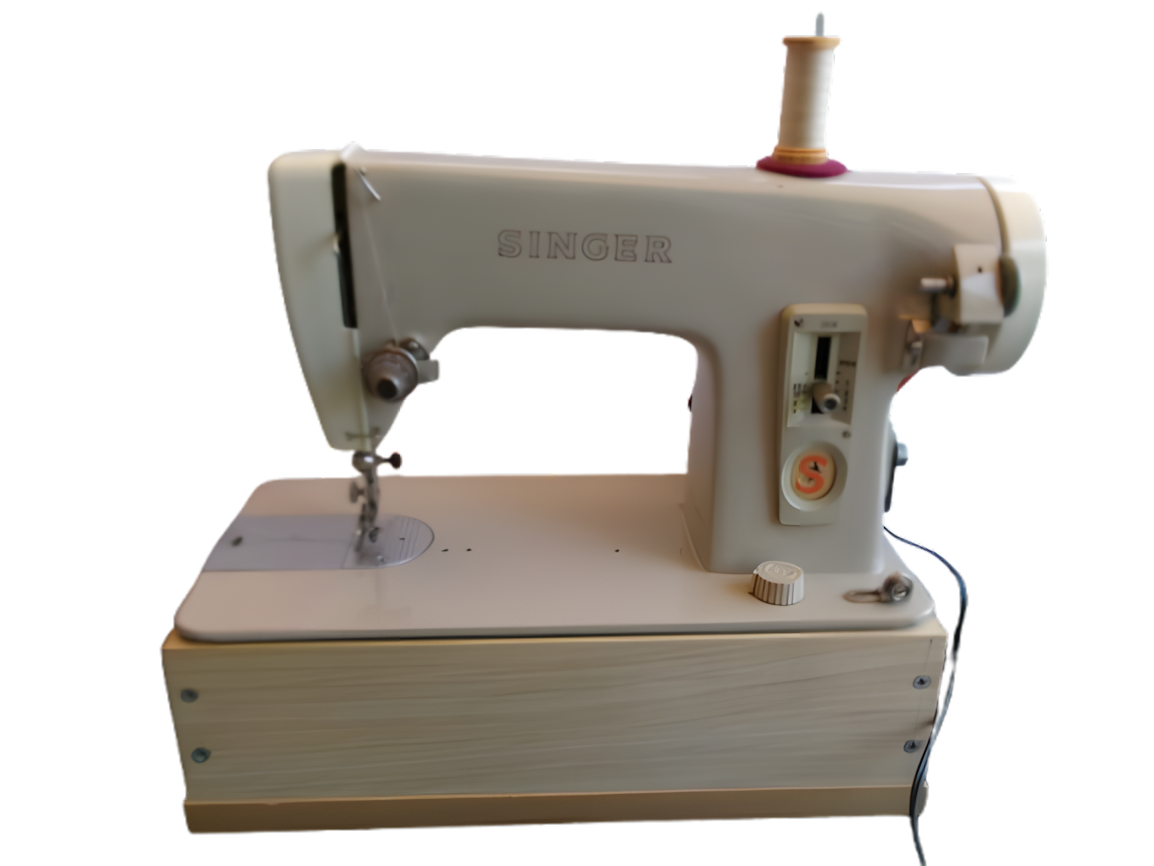
 We’ve all wandered into a thrift shop hoping to stumble across a fantastic deal, right? Well, that’s how I found my 1963 Singer 293B sewing machine—a little French beauty that never really got the love it deserved from the American sewist.
A bit about the model: the Singer 293B is a straight-stitch-only machine. That’s it. No zig-zag, no buttonhole, just good old straight stitch. And the color? Beige. Not one of those fancy whites, blacks, blues, greens, or combos—just plain beige. But hey, it had character!
I picked it up in 2021 for $5. It wasn’t in a cabinet or box; it had clearly been forgotten in the corner of a room or basement for decades. Rust had made its home on and inside it. The needle plate was scarred with pit marks from years of use—and the whole machine was basically seized up. The tension disk knob, which normally goes from 0–9, only moved from 0–4. The stitch length lever was bent, and the tension disks weren’t moving at all.
I got to work with some penetrating solution, letting it soak in and work its magic. Slowly, the machine started to move again, and I was finally able to do a complete restoration and tune-up. I smoothed out the needle plate scars, got rid of all the rust—including the sneaky rust behind the stitch selector lever—and replaced the bent lever. I even took apart the tension disk selector, cleaned it thoroughly, and put it back together correctly (apparently, it hadn’t been assembled right in the first place, which is why it wouldn’t go past “4”).
I really wish I had taken a video before all the cleaning—it was days of disassembling, scrubbing off rust, and reassembling. But it was so worth it. Once I lubed it up, it moved beautifully again, ready to sew like it should.
In a follow-up, I’ll share the story of cleaning up the motor and tackling a few other little troubles.